I saw the news reports today from the shootings in El Paso, Texas and Dayton, Ohio. My heart grieves for all the people who were loved. I wanted to share a story about why these are so hard for me, and something that has been churning around inside my head…
For a couple of years at my former job, I was part of a team that trained leadership at manufacturing sites and tech centers about how to communicate before, during and after an active shooter event. We ALWAYS involved the local police, to establish a relationship and to get their expertise. And we acknowledged that we couldn’t really train them how to communicate in a crisis without training them about what happens during one.
In 9 out of 10 sessions, we set an active shooter scenario — what happens when someone with a gun enters a facility and starts shooting people. We chose this deliberately, because it has been a rising issue, and as the police said in most places we went, it is not a question of if, but a question of when it will happen to you. Our people needed to know what to do.
The statistics keep going up and up. We were dealing specifically with a workplace setting, but the fundamentals apply, sadly, to schools, places of worship, malls, bars, movie theaters, the street, festivals, grocery stores, etc., etc. No place seems to be safe from violence. The police in all of the towns we visited said, “If a person wants to do this, they will find a way. You can only prepare, train and be aware. If you see something, say something.”
(That last part seems to have become the tagline for the 21st Century.)
Because of my involvement in the trainings, every time there is a news report of one of these incidents, I’m triggered in a way. I become much more alert, watching for the tiny details — how each spokesperson handles themselves, how the reports say people responded. Pretty quickly, I can tell if there was a plan in place, if people had been trained in what to do. In tonight’s reports from El Paso, the news mentioned that in one place a small school-age child ran into a store telling everyone that there was a shooter and that they should run. That little person had gone through active shooter training, at school is my guess. My heart hurts with pride and sadness to know that s/he learned her lesson well.
More and more these reports follow the playbook of what to do during and after an active shooter crisis. I can almost tell you what bullet point will come next during the press conferences and the news reporting.
It’s good to have a plan. A plan helps people get stuff done that needs to get done.
I’m thinking though now we need a larger plan. A plan to get this to stop.
For a stretch there, when we were training almost every week for about three months, I began to have nightmares. Sometimes I was driving up to a scene in progress. Sometimes I was one of the employees looking for an escape route. Sometimes it was almost like a movie and I was production assistant, running around checking off the elements of the scene — cue the screaming employees. Now the line of extras fleeing. Now an explosion in the north corner. Now the gunfire gets louder. Now the gunman marches down the hall toward me… I mean toward the camera.
I’d really like to all of this to stop.
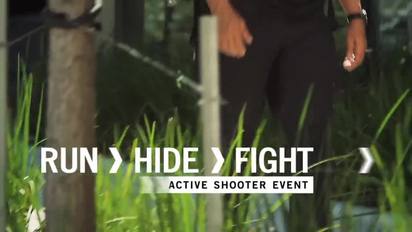
One of the awareness tools we used was a video from the Department of Homeland Security and the Houston Police Department. It’s called simply “Run. Hide. Fight.” It shows the audience three things you can do in an active shooter situation. First, don’t shelter in place — RUN out the nearest exit. Help people if you can, but get the hell out. If that isn’t an option — HIDE. Find a room with a door you can barricade. Turn off the lights and silence the phone. If that isn’t possible, the third option is to FIGHT. Find a weapon and commit yourself to do or die.
(Seriously, it’s a little scary that the above paragraph is almost verbatim from the film. I almost should put quote marks around it.)
I think as a country, we have applied two of the three strategies. Not exactly in the right order. First, we hid. We told each other to hide from the bullets, from the root causes of the violence, from facing the truth.
When shooting became so commonplace, we could no longer ignore it or hide. These horrors ceased to be something that happened to other people. When adults walked into elementary schools and killed babies, then… then we taught our children how to run. We taught ourselves to run. Run away and hide. Run away and wait for the calvary.
But the gun power seems to have outgrown the men on horseback, the rescuers and the helpers. They are responding as fast as they can, but as we saw in Dayton, it takes less than 2 minutes to end lives.
In the aftermath of these events, glimmers of hope begin to rise from the carnage. Stories of heroes who fought to stop a rampage start to emerge. We are told of heroes who saw something and said something. We see profiles of many brave souls who sacrificed themselves. Stories of those who helped others and then turned to fight.
In these scary times, we need the stories of our heroes. We need these men and women who acted and fought. And we need the words of their bravery and sacrifice. We need the positive words give us hope, to inspire us, to show us the path forward. We need the words to shine light in the darkness.
Because, it is definitely time to stop hiding. And to stop running away. To stop blaming. We need to act, to find courage inside ourselves to do the right thing.
Some are yelling at the top of their lungs. Some are praying. Some are giving money and support. These are good things. But we need more.
In almost every instance, we figure out the motive. Now we need a coordinate plan to address these things. We need to make the hard but important choices. All of us need to FIGHT MORE. All of us, together.
We have the tools. We can end hate speech. Make it as unfashionable and not tolerate it ANYWHERE. Teach our children about honor and truth and courage and equality and love. We can make it unacceptable to discriminate “others” — based on gender, race, orientation, ethnicity, ability, ET AL. We can raise awareness about mental illness and create a system that helps those who need it. Why can’t the new jobs of tomorrow be in mental health care?
Hell, I don’t know all that we need, all of the tools we can use. I just know that we are not helpless and that there are many smart people out there to help. You, me, your friend, your cousin, your teacher… We need common sense. We need a plan. We need to stop the hate. We need to stop waiting. We need to act.
 Christina's New Deal